
Self-introduction
Welcome to my personal homepage! I am Zhang Jianghong, a Ph.D. candidate in Materials Science and Engineering at Nanyang Technological University (NTU), Singapore. My academic journey is rooted in the pursuit of innovative solutions for sustainable energy and material development, with a focus on high-entropy materials and multiscale simulations.
Throughout my academic and research career, I have cultivated expertise in the development and optimization of electrocatalysts for water-splitting applications. My work is fueled by a curiosity to bridge fundamental science and practical applications in material innovation.
Beyond research, I have had the privilege of contributing to academia as an invited journal reviewer and mentor, and I take pride in fostering a safe and collaborative laboratory environment. I am also a recipient of several prestigious awards, including the Gold Medal at the Chinese College Students’ “Internet Plus” Innovation and Entrepreneurship Competition.
Feel free to explore my projects, publications, and interests. Let’s connect and collaborate to make a difference in materials science and engineering!
Selected Projects
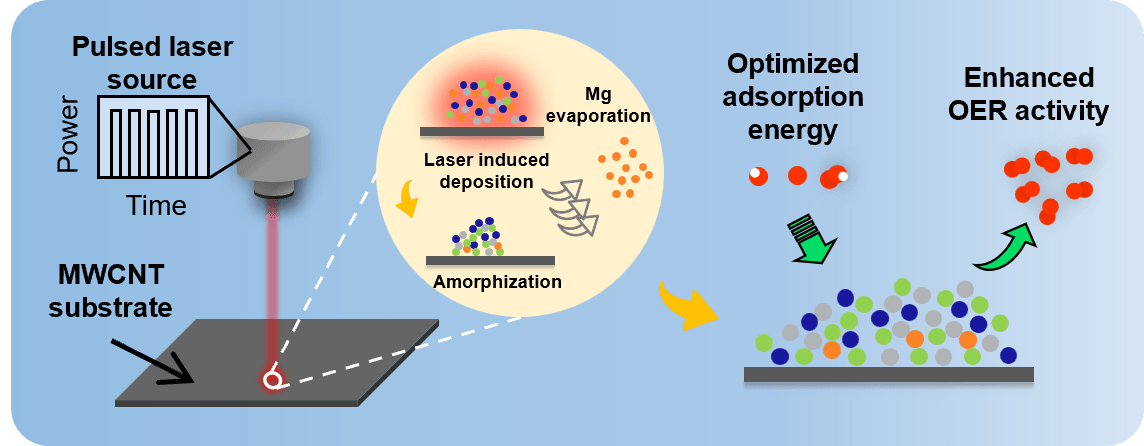
Multi-principal element alloys (MPEAs) have been recognized as emerged electrocatalysts that facilitate the high efficiency for oxygen evolution reaction (OER). With the noble metals free, they are cost-effective and a potential candidate to replace the traditional RuO2 and IrO2. The catalysis can be further improved through the construction of their lattice structures. This study proposes an innovative approach which makes use of pulsed laser irradiation to synthesize nano-sized amorphous MPEA particles. The low-boiling-point element Mg is incorporated with Fe, Co and Ni to synthesize MPEAs (FeCoNi)1-xMgx (x=0.05, 0.15, 0.25, 0.35). The high thermal temperature generated during the interaction between the laser beam and MPEAs gives rise to the evaporation of Mg leading to the amorphization. The increase of Mg content intensifies the amorphization extent. (FeCoNi)0.65Mg0.35 achieves a lower overpotential (256 mV@10 mA/cm2) for OER compared to the crystal counterparts and demonstrates long-term catalytic stability. Theoretical calculations reveal that amorphization strengthens OOH* adsorption energy due to improved charge transfer. This research provides insights into novel synthesis strategies and the catalytic mechanisms of amorphous alloys. Keywords: multi-principal element alloys (MPEAs), amorphization, pulsed laser irradiation, oxygen evolution reaction (OER), electrocatalysts.
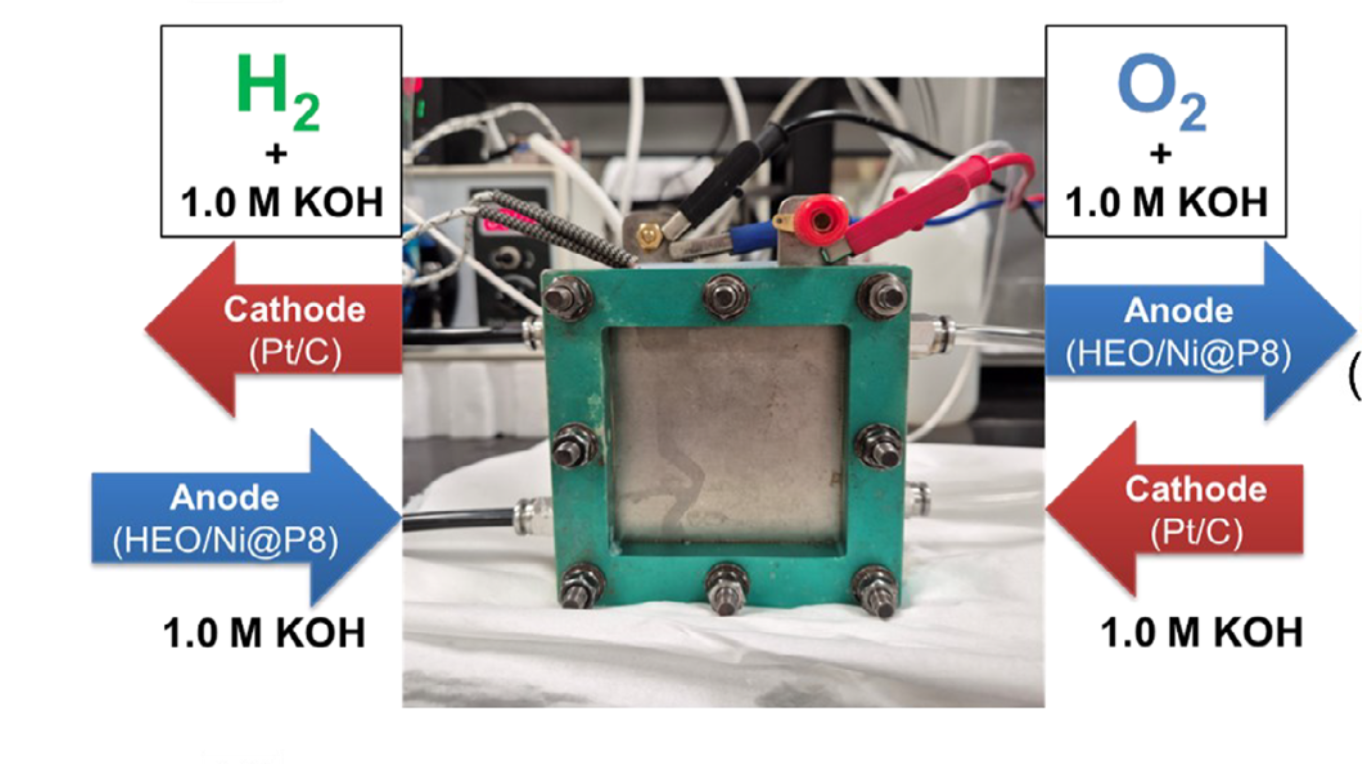
High entropy oxides (HEOs) have recently emerged as excellent alternative catalysts that can potentially replace noble metal catalysts such as RuO2 and IrO2 for water splitting applications. However, existing methods of synthesizing these catalysts are often tedious. In this work, a straightforward method is proposed using ultra-fast laser irradiation to synthesize heavily wrinkled noble metal-free (CoCuFeMnNi)3O4 HEO 2-D sheets on nickel foam for excellent oxygen evolution reaction (OER) performance. These sheets facilitate the OER at a low overpotential of only 245 mV to achieve 10 mA/cm2 and is stable after 100 h of testing. This performance outmatches the majority of recently reported noble and noble metal-free HEA and HEO catalysts. As an anode in anion exchange water electrolyzer (AEMWE), a remarkably high current density of 1.722 A/cm2 is achieved at 2.0 V with negligible catalyst deterioration despite 70 h of testing. This result outranks the majority of other state-of-the-art AEMWE catalysts reported today. This work proves that laser irradiation synthesis enables the synthesis of efficient HEO catalysts, and is a pioneer synthesis of HEO 2-D interconnected sheets using laser irradiation. Crucially, this work proves that noble-metal free HEOs are highly efficient and durable catalysts in industrial AEMWE devices.
Recently, silver nanoparticles (AgNPs) have been widely applied in sterilization due to their excellent antibacterial properties. However, AgNPs require rigorous storage conditions because their antibacterial performances are significantly affected by environmental conditions. Instant fabrication provides a remedy for this drawback. In this study, we propose a self-powered electrodeposition system to synthesize sub-10-nm AgNPs, consisting of a triboelectric nanogenerator (TENG) as the self-powered source, a capacitor for storing electrical energy from the TENG, and an electrochemical component for electrodeposition. The self-powered system with larger capacitance and discharging voltage tends to deliver smaller AgNPs due to the nucleation mechanism dominated by current density. Furthermore, antibacterial tests reveal that compared to direct current (DC) electrodeposition, the TENG-based electrodeposition can synthesize finer-sized AgNPs (<10 nm) with overwhelming antibacterial effect against Escherichia coli (E. coli) and Staphylococcus aureus (S. aureus) (with 100% efficiency at 2 h). This work provides a new strategy for the self-powered, instant, and controllable electrodeposition of nanoparticles. Keywords: multi-principal element alloys (MPEAs), amorphization, pulsed laser irradiation, oxygen evolution reaction (OER), electrocatalysts.